Prison Marriage for $2,000 a Month: The Shocking Truth
Sadie was twenty-seven when she agreed to a prison marriage that paid $2,000 a month. She told herself it was only paperwork, a way to keep a roof over her younger brother’s head. She had no idea the woman writing the checks had already studied every weak spot in her life.
Three years later, the man she married walked out of a courthouse. Eight nights after that, he set a black box on her kitchen table, and what was inside changed everything she believed about love, money, and the people who think they can buy both.
The Rent Notice That Started a Prison Marriage
The final rent notice was taped to the apartment door one ordinary morning. Sadie peeled it off fast, but her brother Owen had already seen it.
Owen was seventeen and growing faster than his secondhand sneakers could keep up. He was also too proud to ask why dinner lately tasted more like water than soup.
He asked her whether things were bad. She tried to joke it away, calling the notice nothing but paper pretending to be important. Owen didn’t laugh, and he asked again.
Sadie had been raising her brother on her own, with no parents around to lean on. She had recently applied to legal aid for help with the rent and with Owen’s guardianship papers, hoping someone, somewhere, might throw her a rope.
Two hours after she found the notice, her phone rang. The caller worked for a woman named Celeste, the mother of a prisoner named Jonah, and Celeste had gotten Sadie’s name through that legal aid application.
A less tired version of Sadie might have hung up right then. But desperate people tend to listen one moment longer than they should. The landlord was waiting, Owen needed shoes, and pride had never once paid the electric bill.
So she agreed to a meeting.
An Offer That Smelled Like Money
Celeste’s office smelled of lemon furniture polish and old money. Sadie sat across from her with one eye on the clock, explaining that her shift started in an hour.
Celeste promised to keep it short. She was offering $2,000 a month, and what she wanted in return was simple: Sadie’s name.
Her son Jonah was serving twelve years. Celeste explained that he needed a wife on paper, someone who would visit twice a month, write letters, and show the court he still had family. Courts, she said, like to see roots.
The idea of a prison marriage stunned Sadie. She asked the obvious question first: was Jonah dangerous?
Celeste didn’t hesitate. Her son was entitled, careless, and foolish, she admitted, but not dangerous.
When Sadie asked why she had been chosen, Celeste smiled and said it was because Sadie understood responsibility. The smile was soft, but something underneath it felt sharp.
Every instinct told Sadie to walk out. Then she pictured Owen coming home from school and pretending he wasn’t hungry, and the prison marriage suddenly felt less like a choice than a lifeline.
She set one condition. The first payment had to land before the wedding, and Celeste agreed without blinking.
Telling Owen the Truth
When Sadie broke the news at home, Owen looked at her as if she had turned into a stranger. He couldn’t believe his sister was marrying a man behind bars.
Sadie insisted the prison marriage was only on paper. Owen shot back that she had sold herself to keep him in school.
She told him she had done it to keep a roof over their heads. He said that wasn’t really an answer, and she admitted it was the only one she had.
His anger faded into something heavier. He offered to quit school and get a job instead.
Sadie refused. He was going to graduate, she told him, get out, and become the kind of man no rich woman could ever put a price on.
Owen looked away first. That was how Sadie knew he understood the prison marriage was not a decision she had made lightly.
A Wedding Behind Scratched Glass
The ceremony took place behind a scratched pane of prison glass. Jonah sat on the other side in a beige uniform, thin and tired around the eyes.
Sadie had braced herself for arrogance or anger from the stranger on the other side of this prison marriage. Instead, the man in front of her looked ashamed.
He told her right away that she didn’t have to pretend he was a good man. She replied that she wasn’t feeling that generous anyway.
Then Jonah confessed. After his father fell ill and his trust was frozen, he had taken $18,000 from a restricted foundation account. At the time, he had told himself he was simply borrowing from his own future.
Sadie called it what it was: stealing. Jonah agreed without arguing.
But he insisted he had not taken the $600,000 that had been pinned on him. That, he said, was his cousin Dean, who had moved the larger funds, forged Jonah’s name, and let Jonah’s smaller mistake make him the perfect person to blame.
Sadie asked why he had let them bury him. Jonah glanced toward the guard before answering that he had already hated himself enough to believe he deserved it.
So Sadie signed the papers, and so did Jonah. Just like that, her prison marriage was official, and the rent money was real.
Letters That Weren’t Supposed to Matter
At first, Sadie treated it like a performance. She visited twice a month because Celeste’s checks kept clearing.
Her letters were carefully balanced, warm enough to look convincing and vague enough to mean nothing. She never expected much in return.
Jonah always wrote back. His letters were neat, and the margins were filled with little sketches: a coffee cup, a tired waitress, and once Owen drawn as “Captain Algebra” after Sadie mentioned he had failed a math quiz.
At her next visit, Jonah asked whether Owen had retaken the test. Sadie was startled that he remembered such a small detail.
He pointed out that she had written it down. She said she wrote a lot of things down, and he told her he read every one of them.
That bothered her more than she wanted to admit. Her prison marriage was teaching her something she hadn’t expected: kindness is far harder to ignore than cruelty.
The Date That Didn’t Add Up
One night, after an exhausting double shift, Sadie sat on the kitchen floor with Jonah’s case file spread all around her. Owen stepped over the pages holding a bowl of cereal.
Half joking, he asked whether this was something fun or more of her prison husband homework. She said it was the second one and asked him to look at a date.
The date was October fourth. On that day, Jonah was already in custody.
That meant he could not have signed the transfer order that carried his name. Owen guessed the answer right away: Dean.
Sadie believed Dean had copied Jonah’s signature. When Owen asked if she could prove it, she admitted she couldn’t, at least not yet.
Owen set down his cereal and asked what she needed. For the first time in a long while, Sadie didn’t feel alone in her prison marriage.
She told him she needed a timeline.
Building a Case One Date at a Time
Women who live close to the edge learn to notice dates. Rent due dates, shutoff dates, court dates, and the day a school fee suddenly doubles.
So Sadie built Jonah’s case on dates. Her prison marriage had started as a paycheck, but now it had become a puzzle she refused to leave unsolved.
She and Owen taped sheets of paper across their wall. They listed every transfer, every signature, every witness statement, and every day Jonah had been locked up while someone claimed he was signing documents.
Sadie took the timeline to a legal aid attorney who looked worn out before Sadie said a word. The attorney reminded her that Jonah had admitted taking money.
Sadie said she knew exactly what he had done. She wasn’t asking anyone to make him clean. She wanted them to prove who had made him look dirtier than he was.
The attorney finally looked at her properly. She warned that families like Jonah’s are very good at burying their mistakes neatly.
Sadie told her to bring a shovel, then.
Three Years That Tested a Prison Marriage
The fight took three long years. It meant prison visits, court hallways, a pro bono appellate lawyer, missed shifts, vending-machine dinners, and pleading with people to read just one more page.
Celeste warned her twice. She told Sadie she was confusing loyalty with intelligence, and Sadie answered that she was finally learning the difference.
Even Jonah tried to stop her once. He said she was wasting her life on a prison marriage and offered to ask his mother for more money if that was what she needed.
Through the scratched glass, Sadie told him it was her life, and she would decide what to do with it.
His eyes filled with tears. That was the moment Sadie realized she loved him, not because he was innocent, but because he was finally trying to be honest. What began as a prison marriage of convenience had quietly turned into something real.
Freedom Didn’t Look Like Joy
Eventually, the judge vacated the conviction tied to the larger theft. Dean’s forged documents and missing records had finally come to light.
Jonah still owed restitution for the $18,000 he had taken. But he was no longer the thief everyone had made him out to be.
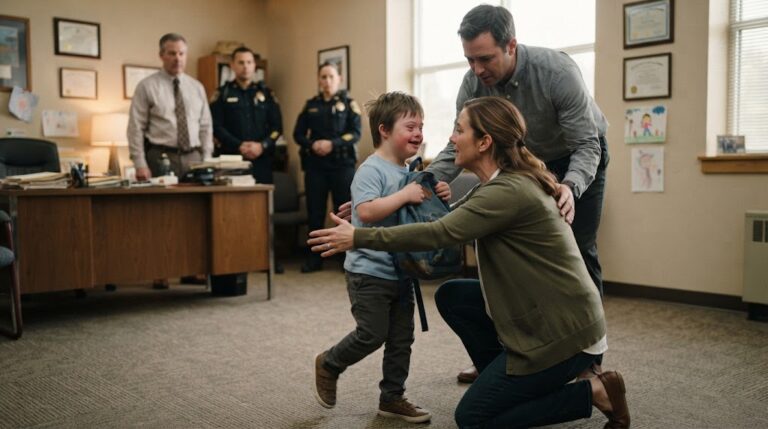
He walked out of the courthouse in a gray suit that hung loose on his thin frame. Sadie had expected joy, yet Jonah looked terrified.
She invited him home. She warned him the apartment was small and that Owen left cereal bowls everywhere, but for that night, it was theirs.
Jonah asked if she was sure. Sadie reminded him that he was her husband, and their prison marriage was still a marriage.
For a week, the three of them practiced being normal. Jonah slept badly, Owen asked careful questions, and Sadie bought groceries without counting her money twice. For the first time, her prison marriage felt like it might become an ordinary one.
Then came the eighth night.
The Black Box on the Kitchen Table
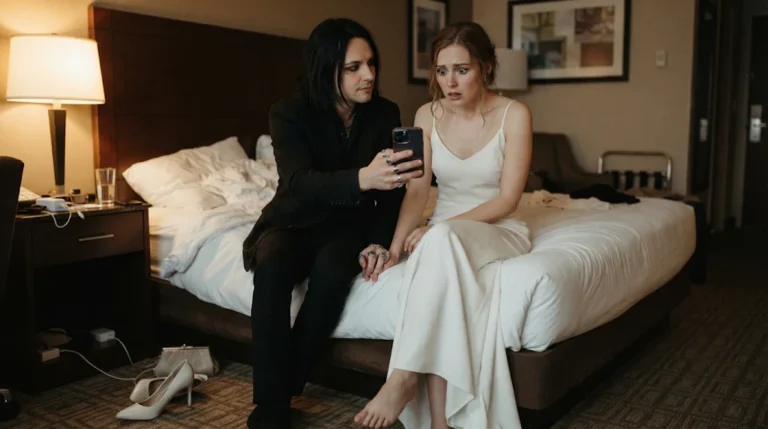
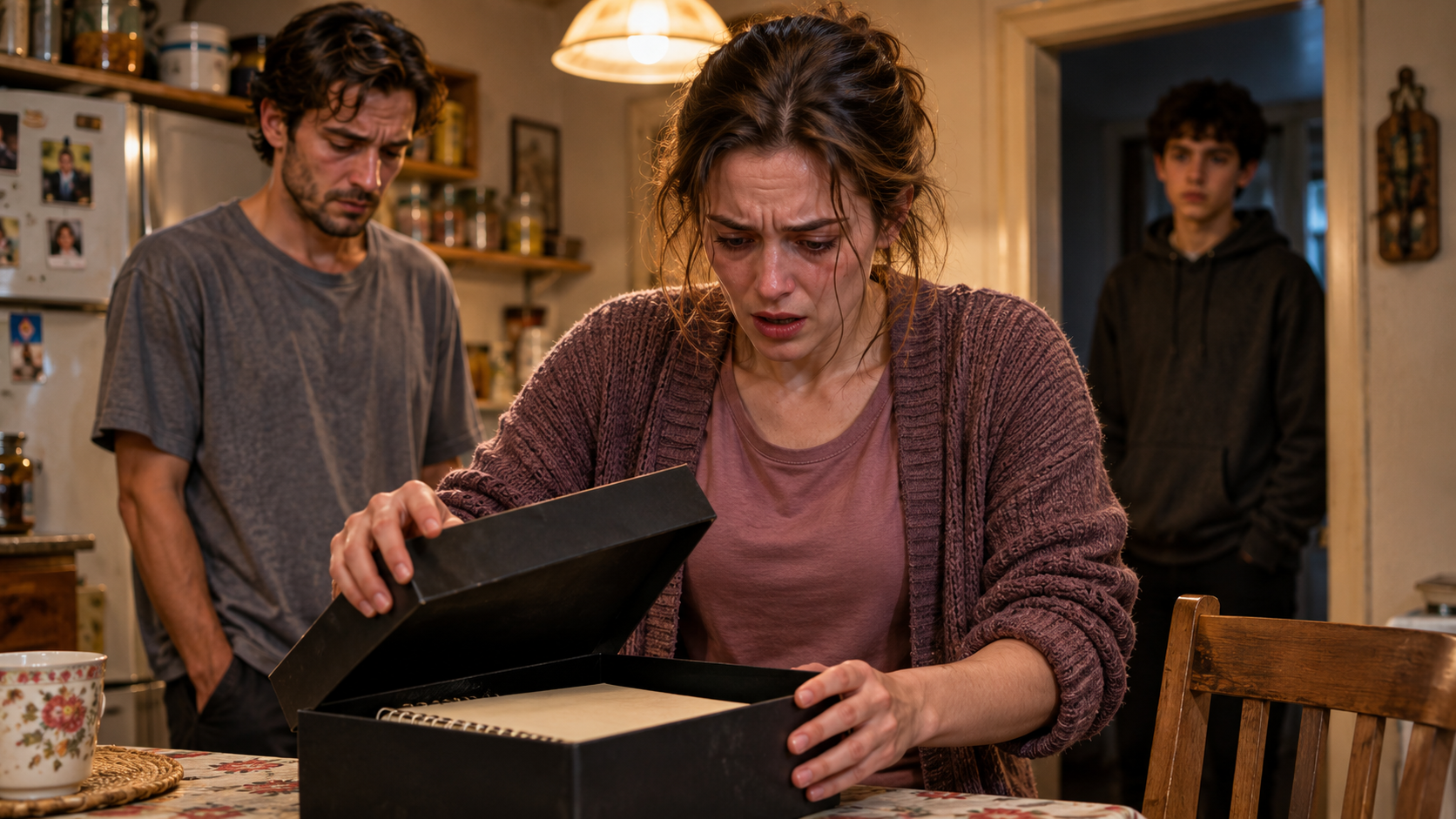
Jonah walked into the kitchen carrying a black box and set it on the table. He said it was his turn to be honest.
Sadie’s hand froze around the dishcloth. She joked that unless the box held back rent and a working nervous system, she didn’t want it.
Jonah didn’t smile. He told her that when she said yes to the prison marriage, she had agreed to something much bigger than his name.
Sadie pushed back hard. She had married him because Owen needed shoes and rent was due, and she wasn’t going to let him dress it up as anything nobler.
Then Jonah said the words that made her stomach drop. His mother had not chosen her by accident.
Sadie refused to open the box until he explained. Jonah told her it held the reason Celeste had picked her, and the reason he had been too much of a coward to tell her once he found out.
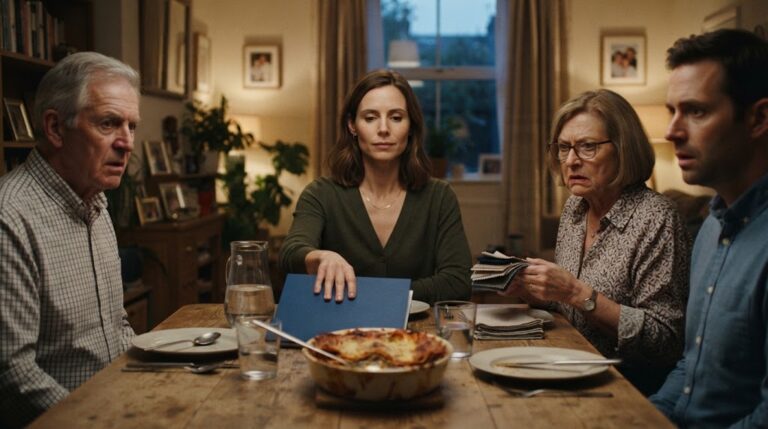
With shaking hands, Sadie opened the latch. Inside lay a cream-colored notebook filled with Celeste’s curling handwriting.
What Celeste Wrote About Her
The notes read like an inventory. No active parents. A minor brother who depended on her. Behind on rent. Likely to comply as long as the payments stayed steady.
For a moment, Sadie couldn’t breathe. Celeste had studied her, and the whole prison marriage had been designed around her weakest points.
Celeste had looked at Sadie’s empty fridge, her long shifts, and her brother’s worn-out shoes. Where others might have seen a struggling young woman, Celeste had seen a handle she could grab.
Beneath the notebook was a trust document with Sadie’s name on it. She read the key paragraph three times before it made sense. She had been named a co-trustee.
Jonah explained that his father had built a safeguard into the trust. If Jonah married while incarcerated and his conviction was later overturned, his lawful spouse would receive emergency co-trustee authority. The prison marriage had never been just paperwork; it was a key to the family’s power.
His father, Jonah said, had understood more than he let on while he was ill. He hadn’t trusted Celeste or Dean.
Celeste had known about the clause all along. That was why she had picked someone she believed was poor enough to control.
Then Sadie asked the question that mattered most: had Jonah known? He admitted he hadn’t at first. He found out six months before the appeal hearing.
A Betrayal Hidden Inside the Prison Marriage
Owen stood in the hallway, listening to every word.
Sadie told Jonah he had let her stand in prison lines for three years without telling her she was part of his family’s war.
Jonah said he had been protecting her. Sadie stopped him and told him to say it the right way.
He swallowed hard. Then he admitted the truth: he had lied by letting her stay in the dark.
Sadie told him that was the first honest thing he had said all night, and maybe the first in their entire prison marriage.
She could own the fact that she had entered the prison marriage for money, she said. But she had loved him by her own choice, and he had betrayed that love.
She gathered the notebook and the trust papers. When Jonah asked where she was going, she told him she wasn’t going anywhere. He was.
Owen stepped to his sister’s side. Jonah looked at them both, lowered his head, and walked out the door.
A $100,000 Check on the Desk
After Jonah left, Owen read Celeste’s notes twice. He said she had written about them like stains on a couch.
Sadie reminded him that Celeste had money, lawyers, board members, and people trained to believe whatever she said.
Owen tapped the trust document and pointed out that Sadie had Celeste’s signature. When Sadie said that didn’t mean she knew how to fight, Owen told her it meant Celeste knew she could.
Those words were still echoing the next morning when Celeste called. In a sweet voice, she said they had business to wrap up.
The office looked exactly the same, yet everything had changed. Celeste opened a folder and told Sadie she had done more than anyone expected.
Then she slid a check across the desk. It was for $100,000, a price tag for walking away from the prison marriage for good.
For a split second, Sadie saw everything that money could buy: Owen’s college, a car that actually ran, six months of rent without fear. She asked what she was expected to sign.
A trustee resignation, Celeste said. She told Sadie she had been paid fairly and shouldn’t turn a prison marriage built on survival into a love story.
Sadie pushed the check back across the desk.
Celeste’s smile thinned. She said women like Sadie survive by knowing when to step aside.
Sadie stood up. She told Celeste that women like her survive by remembering every person who assumed they would quietly disappear.
Celeste warned her to be careful. Sadie answered that she had been careful for three years, and now she was awake.
The Day Sadie Took the Podium
Celeste had planned a donor luncheon to repair the family’s reputation. It became Sadie’s moment instead.
Celeste stood at the podium in a cream suit, while Dean sweated near the front of the room. Jonah and Owen sat in the back.
When Sadie stood, Jonah started to rise too. She shook her head at him, because this part belonged to her.
She walked to the front carrying the black box. Celeste smiled tightly and told her this wasn’t the moment.
Sadie said that was exactly what Celeste had counted on: a woman who would never know when to speak. Dean snapped at her to sit down, and she refused.
She set the black box on the podium and admitted the truth to the room. Celeste had paid her $2,000 a month to enter a prison marriage with Jonah.
Whispers rippled through the crowd. Few people there had known the prison marriage was bought and paid for. Sadie went on: Celeste hadn’t chosen her for loyalty. She had chosen her because Sadie had nothing.
Then Sadie lifted the notebook and read Celeste’s notes aloud to a room full of donors. No active parents. Minor brother dependent. Behind on rent. Likely compliant.
Celeste reached for it and called it private. Sadie said it wasn’t private; it was proof. Celeste had used a trust, a charity, and a vulnerable young woman to hold on to power she was never meant to have, while Jonah took the fall.
Dean jumped up and claimed she was lying. Sadie turned to face him and laid it out plainly: he had moved money under Jonah’s name after Jonah was already in custody, and he had let Jonah’s $18,000 hide his own $600,000.
A board member rose and told Dean not to leave.
Sadie looked back at Celeste one last time. She said Celeste had been wrong to think she was poor enough to rent and tired enough to erase.
The board member stepped forward. He asked Celeste to step away from the podium and told counsel to call an emergency vote suspending her pending review, and to notify the attorney general’s charity division.
Life After the Prison Marriage Scandal
Months passed. Dean faced charges, Celeste was gone from the foundation, and Jonah completed his restitution.
One evening, Jonah found Sadie at the table reading scholarship applications. He paused in the doorway and told her she belonged there.
She said she knew. He told her he should have trusted her, and she agreed. He apologized, and she said she knew that too.
Then Jonah promised he would never try to manage her again. Sadie looked up and told him a promise like that isn’t made once. It has to be proven every single day.
He nodded and said that was exactly what he would do.
Owen appeared in the doorway and asked whether they were eating dinner or doing emotional accountability all night. For the first time in months, Sadie laughed.
What This Prison Marriage Teaches Us
Sadie didn’t forgive Jonah all at once. Broken trust rarely heals in a single conversation, and the scars of her prison marriage didn’t vanish overnight.
Her story is a reminder that powerful people sometimes look at struggling families and see tools instead of human beings. Celeste counted on Sadie staying tired, quiet, and grateful.
What Celeste never understood was that hardship teaches people to pay attention. The same habits that helped Sadie track rent and shutoff dates helped her expose a forgery.
It also shows that love has to be earned through honesty, not assumed. Jonah’s real redemption didn’t come when the judge freed him. It began when he started proving himself, one day at a time.
If you or someone you love is facing a legal fight without money for a lawyer, help may be closer than you think. The Legal Services Corporation funds free civil legal aid programs for low-income Americans across the country. For more real-life stories about family, love, and second chances, visit Techtista.
The first time Sadie said yes to a prison marriage, fear had pushed her into a corner. The second time she chose Jonah, she did it standing tall in the middle of her own life.